From a payment table to a single source of truth
Reorganising Payments around how firms actually manage their money.

Project Overview
Ignition is a billing and payments platform for accounting and professional-services firms.
Payments is where firms manage what happens after they ask clients for money. But the experience had evolved around how Ignition processed payments, rather than how firms managed getting paid.
I led the redesign of Collections, working with Product and Engineering from research through launch. The goal was to turn it from a temporary processing view into a persistent, searchable record firms could use to manage payments every day. I also helped shape the product boundary and the next direction as new evidence emerged.
The Problem
Collections showed where a payment was. Then it lost the record.
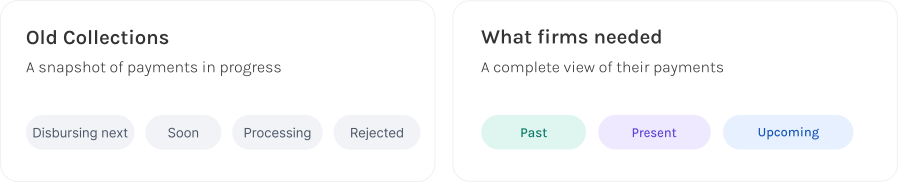
The old collections page was organised around short-term payment and payout states: Collecting (Processing, Paying soon, Next payout), Pending collections, Rejected, Verifying. For a payment in progress, that worked. Firms could see where their money was and when it was likely to reach them.
But firms needed more than the status of a payment. They needed to understand the bigger picture across all of their payments.

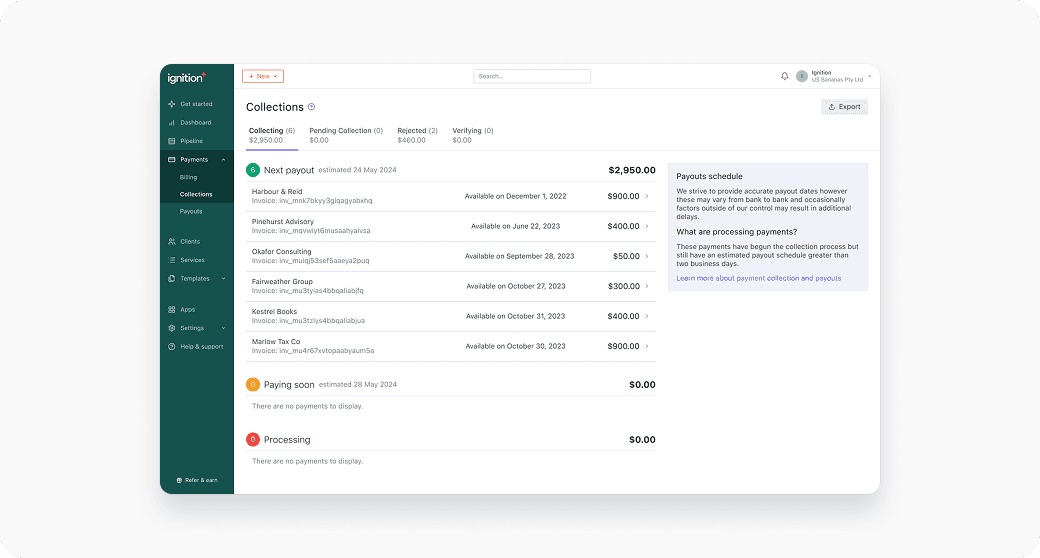
Once a payment was paid out, it disappeared from Collections.
That’s where the experience broke down. There was no history, search, or filtering to look back and understand what had happened to a payment.

Without that history, firms had to create their own record. They cross-checked Ignition against spreadsheets and other systems, adding extra work and, in some cases, the risk of collecting from a client twice.
Define
Deciding what Collections should solve
Research showed that firms needed support beyond tracking individual payments. They were managing several connected parts of getting paid, from invoicing clients to understanding what money was coming next.
But these needs did not all belong in the same product experience. The challenge was to define what Collections should own and where its boundaries should sit.
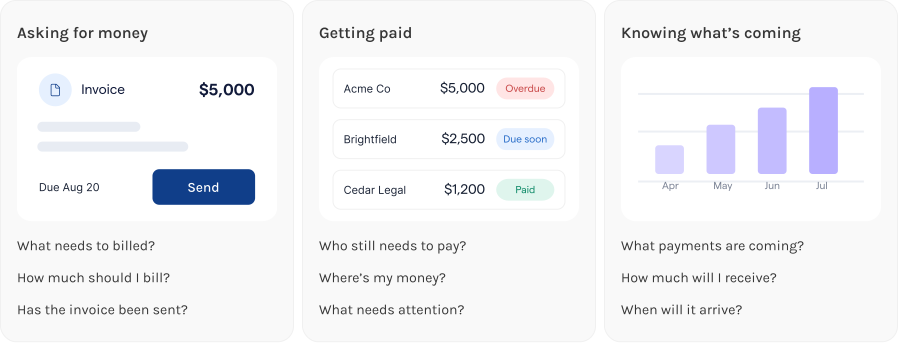
Solving now: Help firms get paid
Complete payment history
Clear status and progress
Failures that need attention
Actions to resolve payment issues
Not solving yet: Broader money-management needs
End-to-end invoicing
Full cash flow forecasting
Broader financial planning
Redesign
Rebuilding Collections around the payment journey
The redesign centred on one idea: make the full payment journey understandable, visible, and actionable, from collection through payout.


01. Match the firm’s mental model: From how Ignition processes payments to how firms think about getting paid
The old Collections page was organised around when Ignition would send funds. That worked for payout timing, but firms had broader questions:
Who’s paid? What’s still outstanding? What needs my attention?
Getting paid involves two movements of money: the client paying, then Ignition paying those funds out to the firm. The old experience made the second clear, but gave much less visibility into the first.
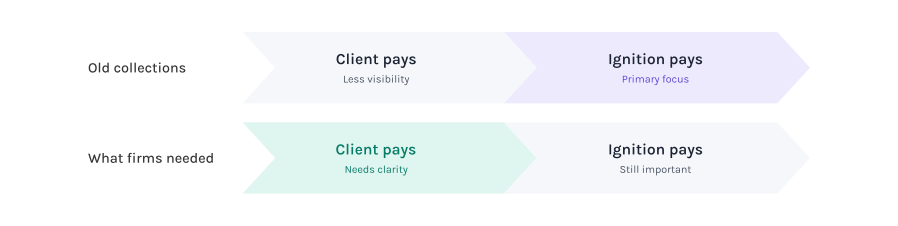
The model, not just the labels, needed to change
Customer insights, competitive research, and testing showed the same gap: Collections reflected Ignition’s payment process, while firms thought about managing getting paid.
So rather than simply renaming the existing states, the experience was reorganised around the firm’s mental model.
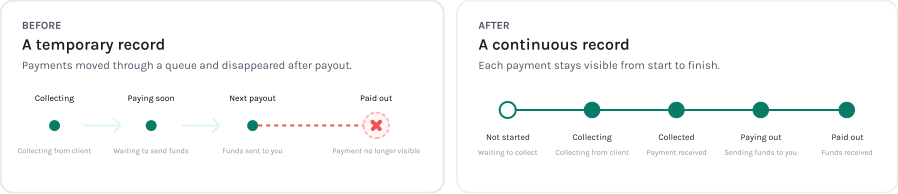
02. Keep the payment record: From a temporary queue to a persistent history
Previously, payments moved through Collections like items in a queue. Once paid out, they disappeared.
The redesign kept completed payments visible, creating a payment history firms could search and return to.
03. Make problems actionable: From seeing what happened to knowing what to do next
The old experience showed a payment’s state, but what to do next was often unclear. Firms had to open the invoice, read through its activity, and work out which actions were available for that payment.
Match the action to the state
A payment can reach sixteen states: the collection lifecycle from not started through to paid out, plus verification, refunds and disputes. Each one has a different sensible next step, and working out that mapping was most of the design work. Sometimes the right answer was no action at all, since nothing can safely change while money is moving.

Resolve issues where they happen
The actions then moved into the payment record itself. Depending on the state, a firm could reschedule, share a payment link so the client pays directly, request a refund, or cancel, without leaving the table or contacting Support.
One place to understand, find, and act on payments.


Evolve
What we learned after launch
The redesign centred on one idea: make the full payment journey understandable, visible, and actionable, from collection through payout.